Sparse-GS2Mesh: 3D Gaussian Splatting Guided by Novel Stereo Views and 2DGS for Sparse View Surface Reconstruction
NeurIPS 2026 Workshop on Physical World Model
Abstract
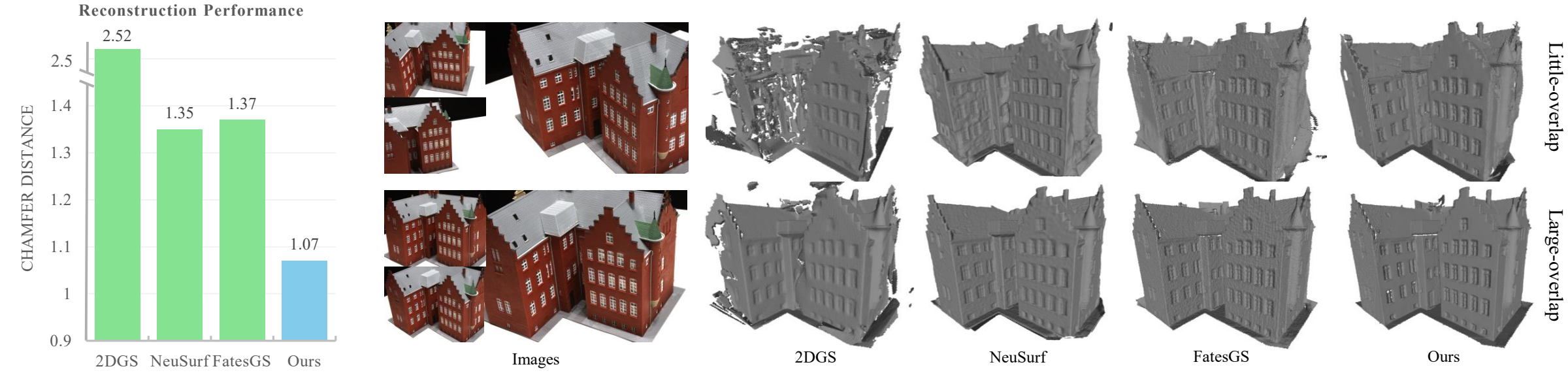
Surface reconstruction under sparse-view settings remains challenging due to limited geometric cues. Volume rendering methods based on signed distance functions often produce over-smoothed surfaces, while 3D Gaussian Splatting (3DGS), though time-efficient, suffers from incomplete geometry due to the lack of reliable depth supervision and the limitation of being optimized only from given input views. In this paper, we present Sparse-GS2Mesh, a stereo-aware framework for surface reconstruction from sparse views. While 3DGS and stereo matching have been leveraged for surface reconstruction under dense view settings, we extend them to operate effectively under sparse view conditions by first initializing 3DGS using epipolar depth priors to mitigate the 3DGS overfitting problem, followed by our three key components: (I) adaptive baseline selection, (II) fine-tuning with a stereo matching network, and (III) 2D/3D co-regularized fine-tuning. Given a warmed-up 3DGS initialized with epipolar depth, the adaptive baseline selection automatically determines a baseline to synthesize for each sparse view. We then fine-tune 3DGS by backpropagating depth-refining gradients from the stereo matching network, effectively specializing the 3DGS for stereo matching. The 2D/3D co-regularization further helps obtain stable reconstruction, addressing weak geometric cues in close stereo views. Sparse-GS2Mesh achieves a 15% improvement over state-of-the-art methods in little-overlap settings and comparable results in large-overlap settings. Codes will be publicly available.
Pipeline Overview
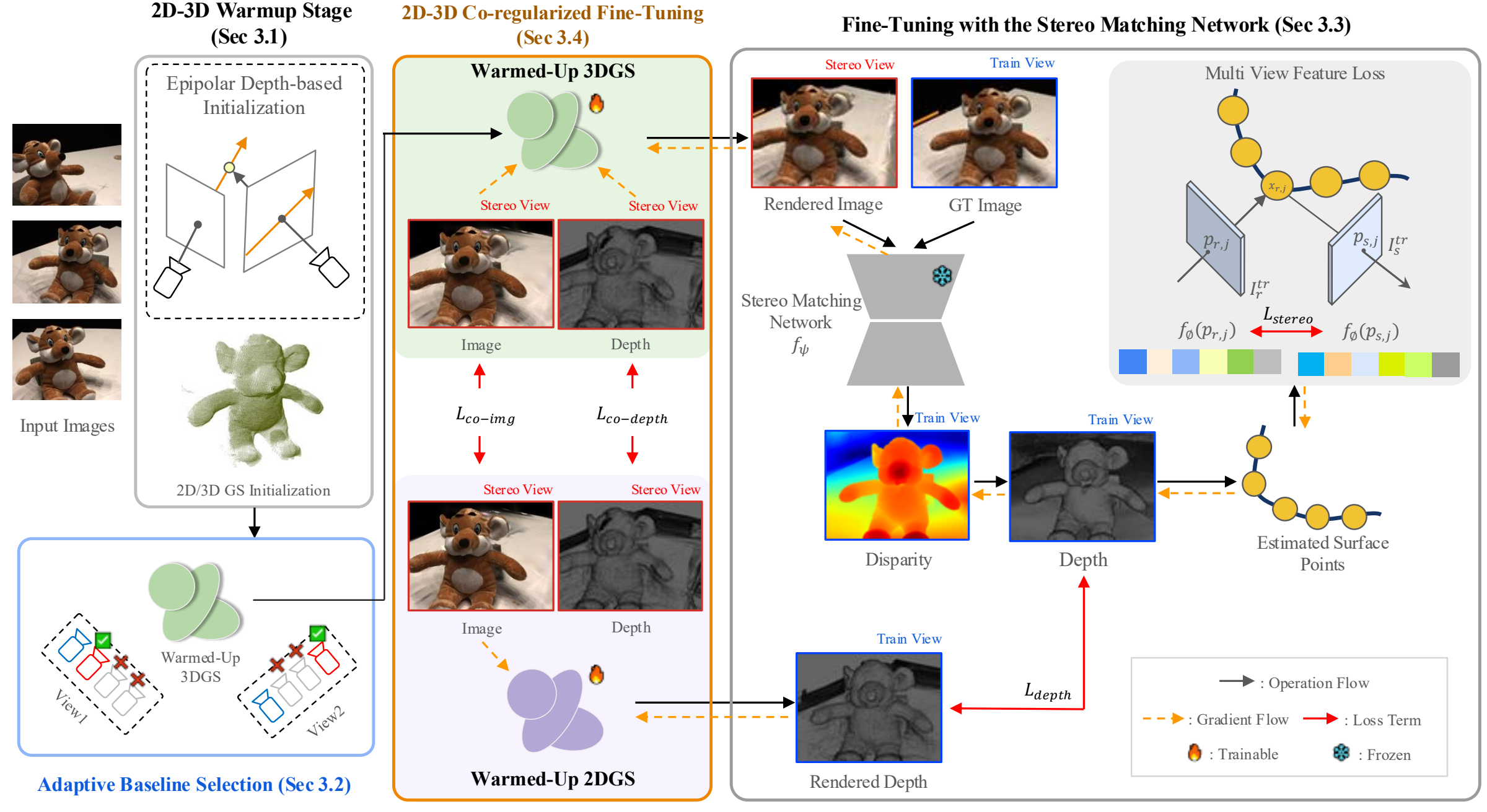
Stereo renderings from warmed-up 3DGS are refined via backpropagated gradients from the stereo matching network. Subsequently, 2D/3D co-regularization with stereo image and depth supervision stabilizes 3DGS geometry, specializing it for stereo matching.
Qualitative Results
Quantitative Results
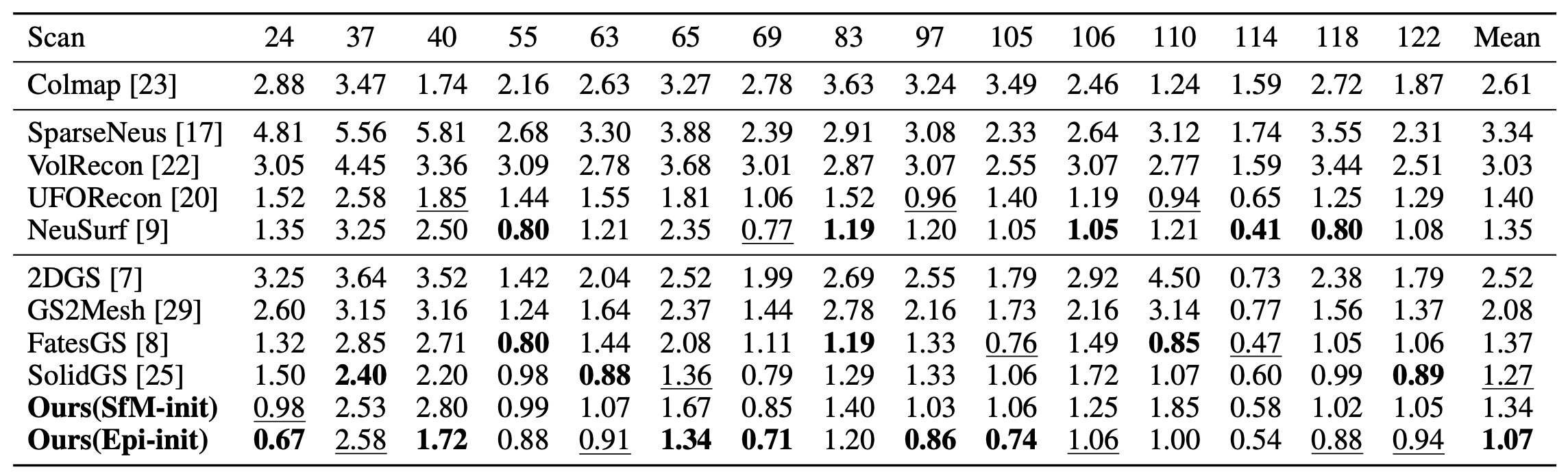
Quantitative comparison (Chamfer distance ↓) on the DTU dataset under the sparse little-overlap setting. Best results are in bold and second-best are underlined.
BibTeX
@InProceedings{noh2026sparsegs2mesh,
  author    = {Noh, Younghyun and Kim, Minje and Kim, Tae-Kyun},
  title     = {Sparse-GS2Mesh: 3D Gaussian Splatting Guided by Novel Stereo Views and 2DGS for Sparse View Surface Reconstruction},
  booktitle = {NeurIPS 2026 Workshop on Physical World Model},
  year      = {2026}
}
Acknowledgements
This work was supported by Institute of Information & communications Technology Planning & Evaluation (IITP) grant funded by the Korea government (MSIT) (No. RS-2026-25522885, Development of a World Foundation Model for Training and Deployment of Physical AI Systems).